
-
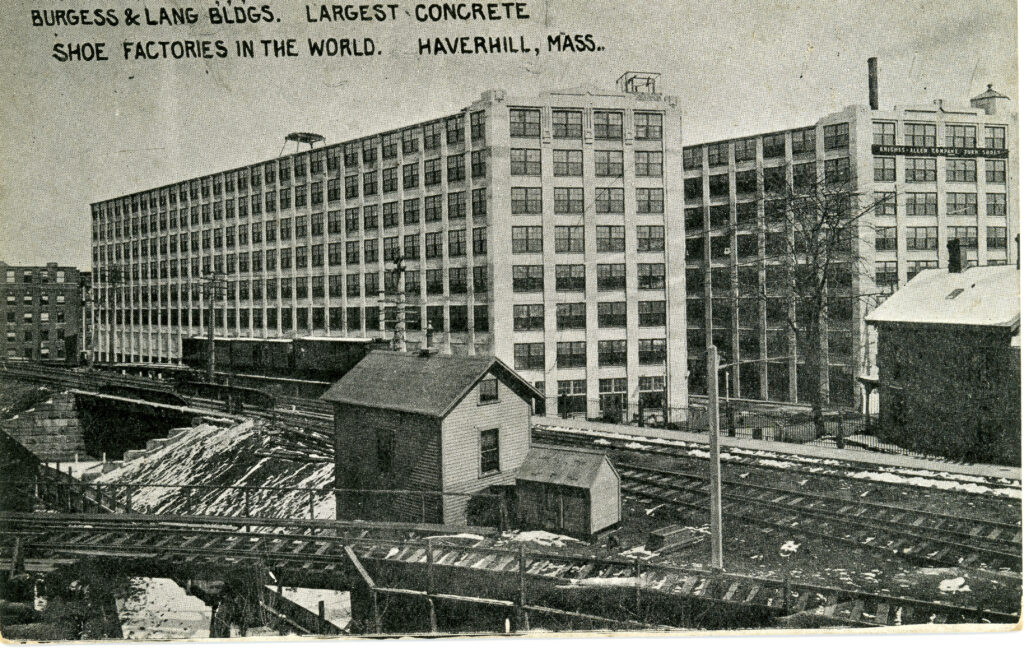
143 and 151 Essex Street in the early twentieth century. The buildings that currently house Historic New England’s off-site collections, at 143 and 151 Essex Street in Haverhill, Massachusetts, were landmarks of industrial design when they were built at the beginning of the twentieth century. The construction of these buildings relied heavily on the labor of Italian immigrants. Approximately three million people came from Italy to the United States between the 1880s and the 1920s, many of them bound for New England, where opportunities beckoned. Industrialized urban centers saw the biggest influx of Italian immigrants and cities like Haverhill soon became home to thriving communities of workers who had left Italy because of economic hardship; political unrest; and a series of natural disasters including a cholera epidemic, drought and crop failure, earthquakes, and the eruption of Mt. Vesuvius in 1906. These events were particularly destabilizing to the south of Italy, although the first Italians in Haverhill came from Genoa, on the northwest coast.
Italian immigrants maintained their customs and practices when they came to the United States. Italian women travelled with their families and often worked from home while minding children, as they had in Italy. As the primary income-earners, Italian men (who emigrated at a higher rate) frequently arrived alone. They settled in boarding houses, finding community with their countrymen. Many saved money to establish themselves before bringing over the rest of their families. Some planned to stay for just a few years, save their earnings, and return to Italy. Others considered themselves seasonal workers; they came every year during the warmer months, worked through the spring, summer, and fall and returned to Italy in the winter when construction work stopped.
During the 1880s, Italian men became a crucial part of the labor force, building industrial and municipal infrastructure. Italy’s long history of sophisticated masonry and concrete use meant that Italian immigration brought masons, plasterers, and construction workers to the United States. Many Italians found work building New England’s roads, bridges, railroads, dams, canals, sewer systems, and public buildings, as well as digging ditches and tunnels for the rapidly expanding transportation network. In Haverhill, for example, Italian workers lived in camps of tents and A-Frame shelters while constructing what is now the Millville Reservoir Dam, a masonry dam built to supply the growing city with clean water.
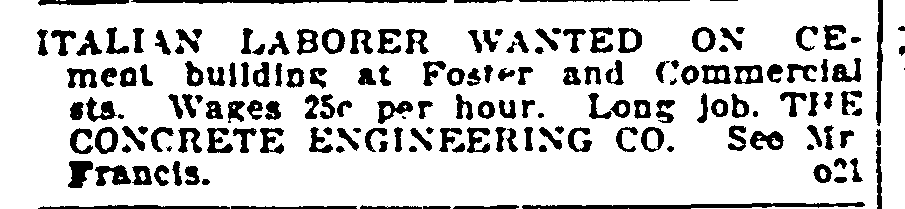
Italian presence in the workforce remained Skilled Italian workers were often sought out by companies like the Concrete Engineering Co., which built 143 and 152 Essex Street. The Evening Gazette (Worcester, MA), October 16, 1912. Many Italians in Haverhill eventually settled along River Street and in the Mount Washington neighborhood along the banks of the Merrimac River. By 1890, the Mount Washington neighborhood had grown so large that the John G. Tilton School was built on Grove Street, and by the turn of the twentieth century a significant number of Italian immigrants had settled in the area, establishing social clubs like the Garibaldi, the Universal Social, and the Liberty Club. In 1900, some of Haverhill’s first triple-deckers were built on Pilling Street in Mount Washington, which was an important development for worker housing in the city. A variety of Italian-owned businesses soon began to appear, from pushcarts to grocery stores.
Fantini Baking Company, established in 1902, is one of the only continuously operating, Italian-owned businesses in Mount Washington—it has been in business for over 120 years. Italian immigrant Sabatino Fantini established it as a small bread bakery, and over the course of five generations, it expanded into a modern, large-scale operation that remains family-owned and operated. Today, Fantini supplies bakeries and supermarkets throughout New England with over ninety products and supports the local community, including a recent donation of new laptops for students at Tilton Elementary School.
When the construction boom in Haverhill slowed, many Italian immigrants went to work at the factories they had built, cutting and stitching shoes or tanning leather. They were an important voice of solidarity in Haverhill’s union struggles as the city’s workers navigated the labor movement. Italian identity remained strong with clubs and benevolent societies like the Order of Sons of Italy in America, which worked to represent Italian culture in civic life at its Victor Emanuel Lodge, hosting social and cultural events throughout the year.
Italian immigration to Haverhill slowed dramatically with the Immigration Act of 1924, which imposed strict quotas favoring northern Europeans. That year, however, a new independent Catholic parish was incorporated in Mount Washington for the Italian community and quickly became a center of social and cultural life, celebrating feast days and holidays as people came together to worship and keep traditions. Notably, the church was named for Saint Rita, “la santa delle cause impossibili”—the Patron Saint of Impossible Causes—evoking the enduring resilience of Italian immigrants who traveled so far from home, helped build the new America, and found their place in it.
Written by Eleanor Martinez-Proctor, Study Center Research Fellow
Explore More: