• In 1895, Haverhill, Massachusetts was at the peak of its industrial power, turning out thousands of shoes each day from its many factories. It was to great dismay of factory owners that, in February of that year, workers across the city engaged in a massive strike, stopping shoe production and crippling local infrastructure. Over 3,500 workers left the factories that winter, demanding wage increases, unions, and a nine-hour day. The interruption to Haverhill’s busy production schedule lasted for over a month, and factory owners rushed to fill the void with replacement workers. They found a ready workforce in immigrants who came from across the Austro-Hungarian empire, including Russia, Poland, Ukraine, Lithuania, Latvia, and Romania. The Great Shoe Strike of 1895 became a key moment in Haverhill’s history, drawing large numbers of Eastern European immigrants to the city for the first time. Many were Jewish, and they gathered in what became the area’s first major Jewish community.
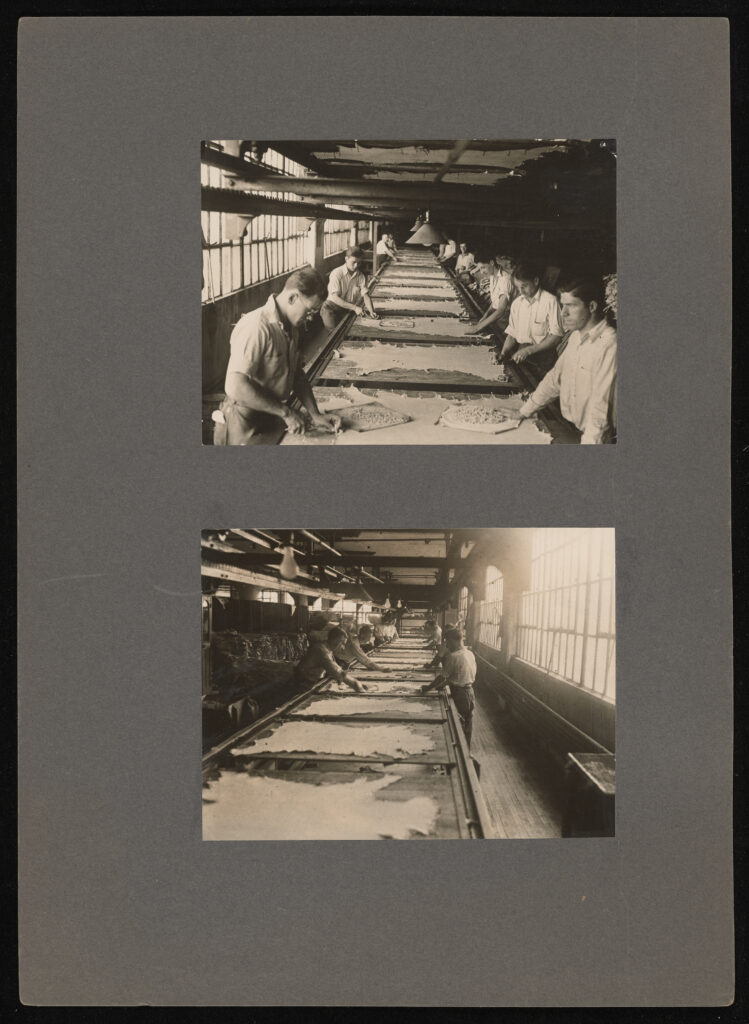
    Men working with skins at L. H. Hamel Leather Company. Courtesy of the Trustees of the Haverhill Public Library, Special Collections Department.

    These new arrivals were fleeing economic hardship, political repression, and the anti-Jewish violence that was spreading across Europe. Haverhill was already home to several other immigrant communities, and the availability of industrial jobs and safe, affordable housing beckoned to those eager to avoid large cities. A small Jewish community had begun settling in Haverhill in the 1880s, led by German and Eastern European peddlers who left Boston and travelled to other Massachusetts cities, becoming storekeepers, merchants, and trades workers. Leatherwork and tailoring were common professions in Eastern Europe, and many immigrants could leverage these skills in the shoemaking and garment industries. H. L. Hamel Leather Company employed many of these workers in cutting, tanning, and finishing leather for shoemaking at their factory complex on Essex Street. As Jewish immigrants established themselves in the profitable shoe and garment trades, they became anchors for chain migrations that followed, bringing large family groups to settle in Haverhill. Many families settled near the factories in the Mount Washington neighborhood and on River Street, sharing traditions from their home countries as they navigated a new world.

    The strike of 1895 brought more than a thousand new Jewish families to Haverhill, but the city had no designated space for Jewish worship. The increasing Jewish population would have no synagogue of their own for many years. In the meantime, Haverhill’s early Jewish residents turned to the home-centered and communal practices they had long relied on in Europe to keep religious practices alive. They did this by using small, quorum-based prayer groups called minyans which met in homes and storefronts. This system was informal and dependent on lay leadership, but it reflected the endurance and resiliency of people who were already experienced in practicing their faith outside of official institutions.
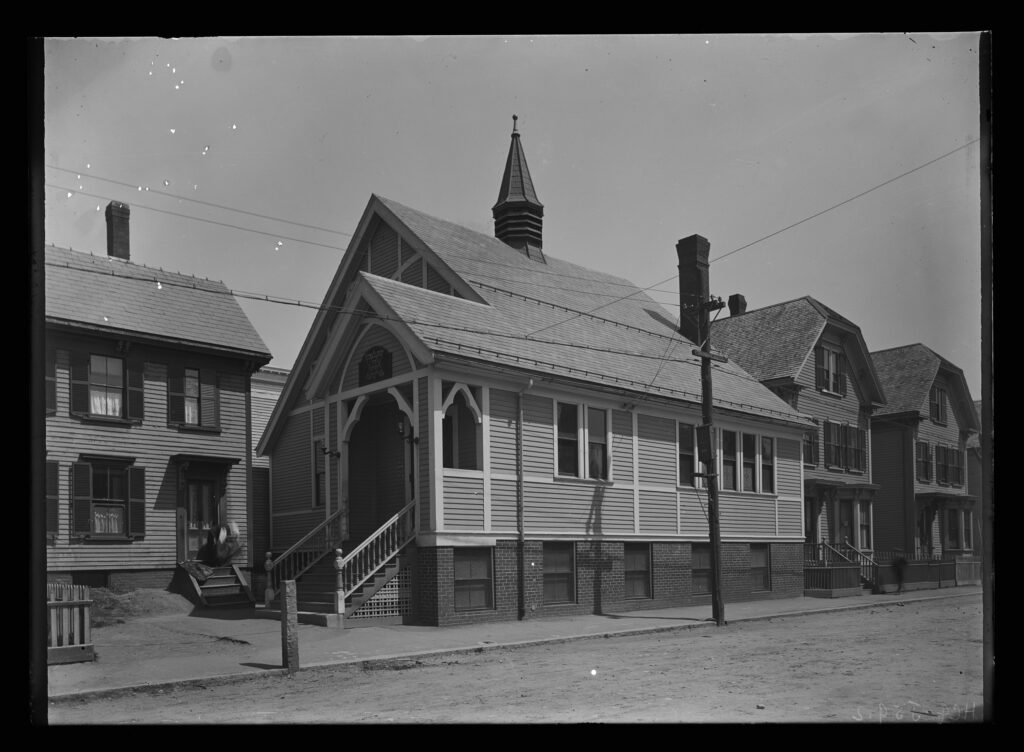
    Ahavas Achim Synagogue, Shepherd Street, Haverhill. Photograph by George W. W. Bartlett, 1916. Courtesy of the Trustees of the Haverhill Public Library, Special Collections Department.

    The use of minyans was crucial to keeping community bonds strong until the founding of the first synagogue, Ahavas Achim Synagogue on Shepherd Street, which had a small but active congregation of Russian immigrants by 1916. Temple Beth Jacob, built on River Street in 1923, followed. By the 1920s, the city’s Jewish population had also begun to spread out from Mount Washington, moving uptown to Main Street and the Highlands area. These more established workers were eager to see a modern synagogue in their new neighborhood. In 1937, the community purchased a former Methodist church at 514 Main Street and converted it to Temple Emanu-El, the largest Jewish congregation in the city. The area’s first full-time rabbi, Rabbi Abraham I. Jacobsen, arrived in 1939 to lead the temple through its formative years, and remained at his post for nearly forty years. Rabbi Jacobsen oversaw a major expansion in 1950 as Temple Emanu-El transformed into a large community center with classrooms, offices, a chapel, a library, and an auditorium/gymnasium. As a religious and community leader, Rabbi Jacobsen helped define spiritual and communal life for generations of Jewish people in Haverhill and the surrounding region.

    Although Temple Emanu-El closed its doors in the spring of 2025, Haverhill remains home to a large and active Jewish community with deep historical ties to the city. The Anshe Sholom Chabad of Greater Haverhill is now the area’s primary synagogue, observing Shabbat services and holidays, as well as providing Hebrew school and other community services. Led by Rabbi Zalman Borenstein, the Chabad center’s mission is “to develop a sense of community, to enhance the experience of being Jewish, to learn and to have fun.” This simple declaration marks the progress of an American journey that began more 130 years ago, in hushed tones and shuttered storefronts, when Jews seeking peace and freedom remained determined to keep the lights of their community burning in every season.

    Written by Eleanor Martinez-Proctor, Study Center Research Fellow
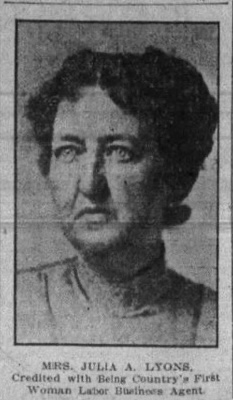
  • At the height of the industrial era, Massachusetts’s booming shoe factories were simultaneously engines of progress and sites of deep inequality. Amid the noise of machinery, women workers began to organize and demand change. In the winter of 1913, Haverhill was in the thick of decades of labor struggles. Although the city’s shoe industry was booming, it had already experienced seven major strikes, and there was no end in sight as tensions mounted between factory owners and unions. That January, the Witherell & Dobbins shoe factory on Essex Street became the site of the city’s next labor dispute. The company was accused of a variety of misdeeds toward its employees, including blacklisting, poor working conditions, and low wages. Women, who made up much of the shoe-stitching workforce, figured prominently in the strike and in the accompanying lawsuit. When negotiations faltered, they received crucial support from another woman: a union agent named Julia Lyons, whose steady leadership soon earned her a place among the top ranks of New England’s labor organizers.

    Black and white photograph of a woman with a serious expression, wearing a high-collared garment. Transcribed Text: MRS. JULIA A. LYONS. Credited with Being Country's First Woman Labor Business Agent.
    The Daily Item, March 31, 1913.

    Julia’s life began in modest circumstances. She was born Julia Ann Drynan on January 1, 1859, to Morris and Catherine Drynan in Salem, Massachusetts. The Drynans soon moved to Lynn, where Julia and her two siblings were raised. Morris was a laborer who died by the time Julia reached her early twenties, after which the family worked in the shoe industry to support themselves. In 1887, Julia married a fellow shoe worker named Martin Lyons. Martin was also a well-known local athlete—an oarsman who rowed for the Father Mathew Society and a member of the Farragut Boat Club’s much-lauded champion crew, which competed on the Merrimack River. The couple lived in Lynn’s crowded Third Ward, a neighborhood of factory workers like themselves whose struggles mirrored those of the workers in Haverhill. Martin worked as a stock fitter, cutting and preparing raw leather for shoemaking. Julia, like many women, worked at the other end of the process, operating small finishing machinery for heels and buttonholes.

    As a part of the industrial workforce, Martin and Julia would have witnessed the growing influence of labor unions and the power of collective action in the first decade of the twentieth century. In 1908, Julia extended her interests beyond the factory floor by helping to organize the local Buttonhole Operators, Finishers, Buttoners, and Eyeletters Independent Union, a local affiliate of the Amalgamated Clothing Workers of America and composed primarily of women. Led by Mrs. Carrie B. Horne, with Julia as secretary, the union became a strong force in Lynn’s labor movement. Together, they negotiated contracts and hosted community events to unify and empower local workers, quickly improving shop conditions and doubling their salaries.

    In 1911, Julia’s life took a sudden and tragic turn when her husband died by suicide. The couple had no children, and Julia never remarried, but whether by wish or necessity, her pace did not falter and in the following years, she dedicated herself even more fully to labor organizing.

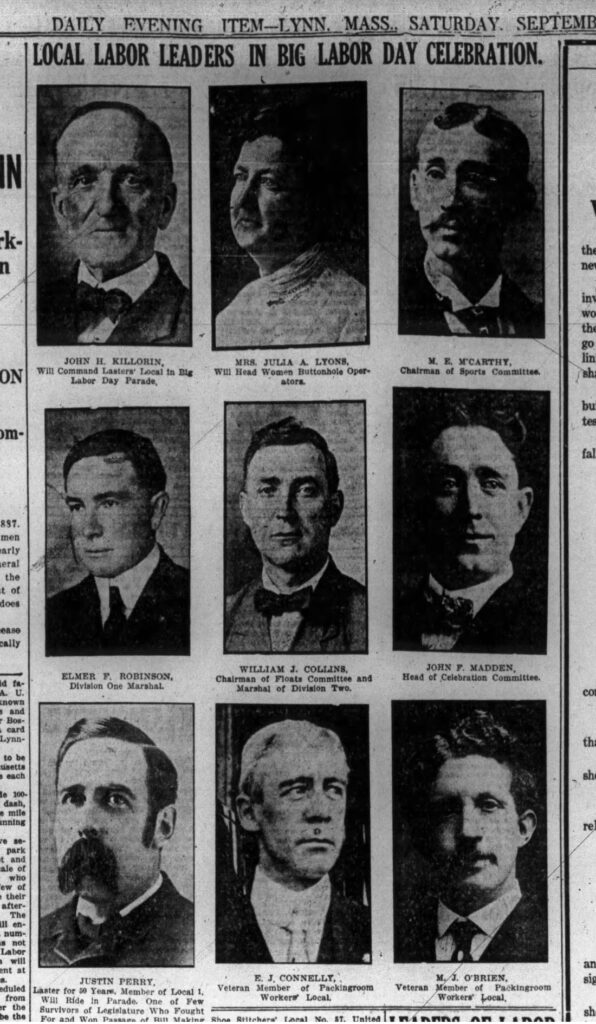
    In 1913, she heard about the stitchers, cutters, and lasters from the United Shoe Workers of America union striking the Witherell & Dobbins factory in nearby Haverhill. More than forty workers, many of them women, eventually testified in court about unfair and abusive treatment by the company. Julia soon became involved in organizing and educating the strikers, as well as making appeals to other unions for support. She was chosen as a member of her union, along with two men from other local unions, to form an advocacy committee to canvass local workers and talk with them about successful strike strategies. By the time the strike concluded, Julia had been elected the business agent of the Buttonhole Operators Union, representing members’ interests on the ground, enforcing contracts, assisting with grievances, and helping with negotiations. She was reportedly the first woman in the country to have earned such a position: a local newspaper reported, “Mrs. Lyons enjoys a unique and distinct honor in being the pioneer among the women labor agents.”

    Julia Lyons featured with her all-male peers. The Daily Item, September 5, 1914.

    After her first term, Julia was reelected unanimously. She stayed on the board of the Buttonhole Operators Union and later served on the executive board of the Women’s Stitchers Local 57. Known as a powerful labor leader, she organized workers’ efforts and supported local political campaigns. During labor unrest after World War I, she helped hold unions together, filing legal actions in 1919 and 1921 against factory owners who hired non-union workers. She fought to enforce agreements, win better pay, and secure union control over hiring. Julia earned widespread respect in a turbulent time and in a field still dominated by men.

    Julia Lyons died in 1922, and her life was defined by her activism. Her legacy continued on in the thousands of workers whose lives were improved by her vision, dedication, and tenacity. As one of the first women to hold a major union office in New England, she helped pave the way for generations of women labor organizers who followed.

    Written by Eleanor Martinez-Proctor, Study Center Fellow

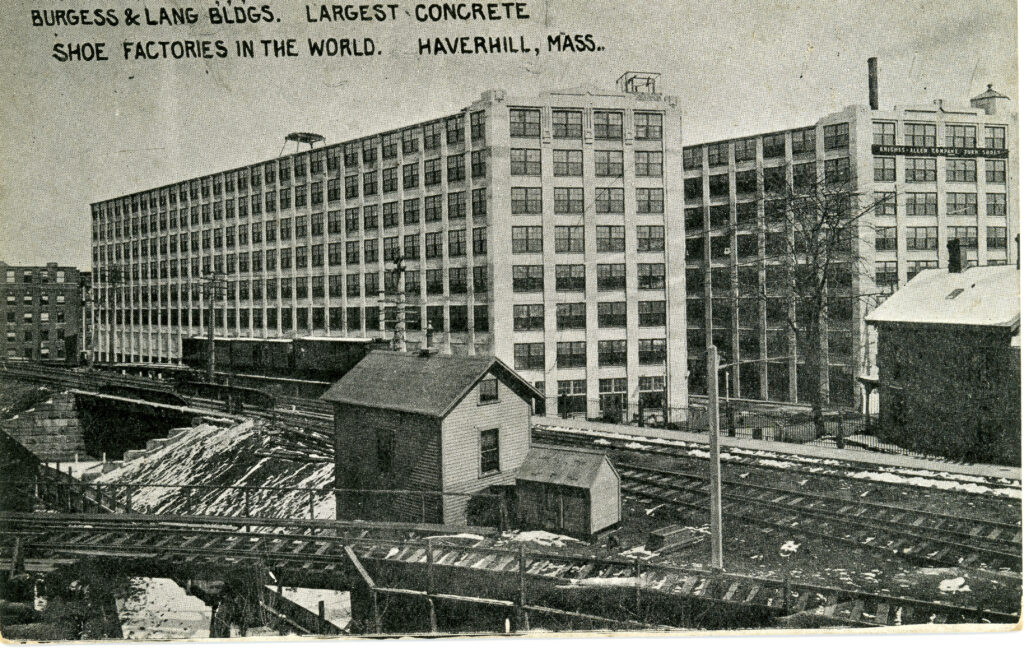
  • 143 and 151 Essex Street in the early twentieth century.

    The buildings that currently house Historic New England’s off-site collections, at 143 and 151 Essex Street in Haverhill, Massachusetts, were landmarks of industrial design when they were built at the beginning of the twentieth century. The construction of these buildings relied heavily on the labor of Italian immigrants. Approximately three million people came from Italy to the United States between the 1880s and the 1920s, many of them bound for New England, where opportunities beckoned. Industrialized urban centers saw the biggest influx of Italian immigrants and cities like Haverhill soon became home to thriving communities of workers who had left Italy because of economic hardship; political unrest; and a series of natural disasters including a cholera epidemic, drought and crop failure, earthquakes, and the eruption of Mt. Vesuvius in 1906. These events were particularly destabilizing to the south of Italy, although the first Italians in Haverhill came from Genoa, on the northwest coast.

    Italian immigrants maintained their customs and practices when they came to the United States. Italian women travelled with their families and often worked from home while minding children, as they had in Italy. As the primary income-earners, Italian men (who emigrated at a higher rate) frequently arrived alone. They settled in boarding houses, finding community with their countrymen. Many saved money to establish themselves before bringing over the rest of their families. Some planned to stay for just a few years, save their earnings, and return to Italy. Others considered themselves seasonal workers; they came every year during the warmer months, worked through the spring, summer, and fall and returned to Italy in the winter when construction work stopped.

    During the 1880s, Italian men became a crucial part of the labor force, building industrial and municipal infrastructure. Italy’s long history of sophisticated masonry and concrete use meant that Italian immigration brought masons, plasterers, and construction workers to the United States. Many Italians found work building New England’s roads, bridges, railroads, dams, canals, sewer systems, and public buildings, as well as digging ditches and tunnels for the rapidly expanding transportation network. In Haverhill, for example, Italian workers lived in camps of tents and A-Frame shelters while constructing what is now the Millville Reservoir Dam, a masonry dam built to supply the growing city with clean water.

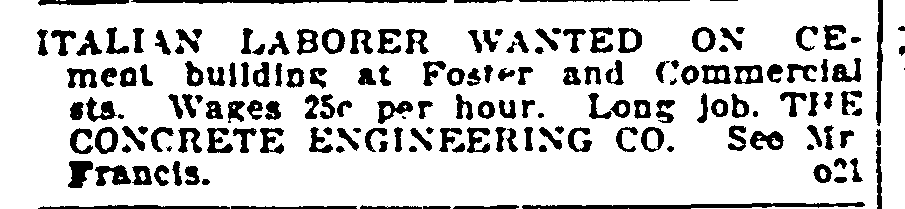
    Italian presence in the workforce remained Skilled Italian workers were often sought out by companies like the Concrete Engineering Co., which built 143 and 152 Essex Street. The Evening Gazette (Worcester, MA), October 16, 1912.

    Many Italians in Haverhill eventually settled along River Street and in the Mount Washington neighborhood along the banks of the Merrimac River. By 1890, the Mount Washington neighborhood had grown so large that the John G. Tilton School was built on Grove Street, and by the turn of the twentieth century a significant number of Italian immigrants had settled in the area, establishing social clubs like the Garibaldi, the Universal Social, and the Liberty Club. In 1900, some of Haverhill’s first triple-deckers were built on Pilling Street in Mount Washington, which was an important development for worker housing in the city. A variety of Italian-owned businesses soon began to appear, from pushcarts to grocery stores.

    Fantini Baking Company, established in 1902, is one of the only continuously operating, Italian-owned businesses in Mount Washington—it has been in business for over 120 years. Italian immigrant Sabatino Fantini established it as a small bread bakery, and over the course of five generations, it expanded into a modern, large-scale operation that remains family-owned and operated. Today, Fantini supplies bakeries and supermarkets throughout New England with over ninety products and supports the local community, including a recent donation of new laptops for students at Tilton Elementary School.

    When the construction boom in Haverhill slowed, many Italian immigrants went to work at the factories they had built, cutting and stitching shoes or tanning leather. They were an important voice of solidarity in Haverhill’s union struggles as the city’s workers navigated the labor movement. Italian identity remained strong with clubs and benevolent societies like the Order of Sons of Italy in America, which worked to represent Italian culture in civic life at its Victor Emanuel Lodge, hosting social and cultural events throughout the year.

    Italian immigration to Haverhill slowed dramatically with the Immigration Act of 1924, which imposed strict quotas favoring northern Europeans. That year, however, a new independent Catholic parish was incorporated in Mount Washington for the Italian community and quickly became a center of social and cultural life, celebrating feast days and holidays as people came together to worship and keep traditions. Notably, the church was named for Saint Rita, “la santa delle cause impossibili”—the Patron Saint of Impossible Causes—evoking the enduring resilience of Italian immigrants who traveled so far from home, helped build the new America, and found their place in it.

    Written by Eleanor Martinez-Proctor, Study Center Research Fellow
  • Never was Boston’s “The Hub” moniker more apt than during the last two decades of the nineteenth century, when the city went wild for cycling. Initially a leisure activity enjoyed by upper-class white Protestant men, cycling quickly took off among people of all classes, backgrounds, and races.

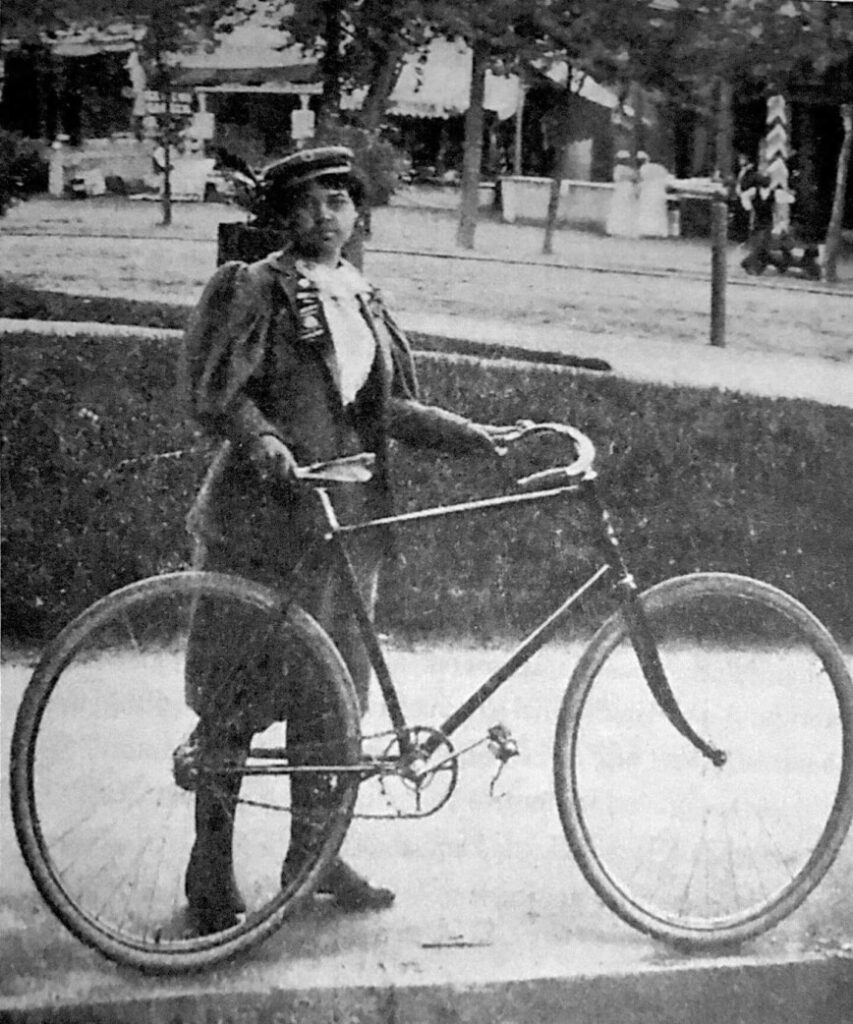
    One of these cyclists was Katherine Towles “Kittie” Knox, a young, biracial female cyclist born in 1874. Her mother raised Kittie and her brother, Ernest, in Boston’s West End, at that time a melting pot of poor Black and White Americans and recent European immigrants. A seamstress who made her own biking “costumes,” Kittie began attracting press attention in 1893: for being Black, for being a woman, for her fashion choices—and for her many biking accomplishments. Throughout her short cycling career (she died of chronic nephritis in 1900), Kittie fought back against gender and race boundaries in order to participate in the sport she loved.

    Plays in Place, which partners with museums, historic sites, and other cultural institutions to create theatrical plays and presentations, brings Kittie Knox’s story to life through The Kittie Knox Plays—including performances at the Eustis Estate in Milton, Massachusetts. Patrick Gabridge, Producing Artistic Director and writer of one of the three Kittie Knox plays, and Claire Gardner, writer of the third play in the trilogy, shared their insights about the process of creating The Kittie Knox Plays and the importance of telling her story with Eustis Estate guide and program assistant Christina Gagliano.

    How did you first hear about Kittie Knox?

    Patrick: Writer/historian Larry Finison brought Kittie to my attention. He’s relentless in his efforts to let the world know about Kittie and that period, and his book Boston’s Cycling Craze, 1880-1900 and other writings are great at telling the story. Usually, Plays in Place doesn’t take on unfunded projects—we’re brought on by a museum or historic site, and they raise the money and we produce site-specific plays. But, in this case, the story and the character of Kittie were just too compelling to pass up, so I said, “Let’s do it.” 

    The Kittie Knox Plays is a trilogy of short plays, each one 25-30 minutes long. Why did you decide on this format?

    Patrick: I wanted diverse voices telling this story. It’s helpful to think of the plays as a collection: They work very closely together and share the same characters and same actors. Thematically, we’re looking at characters struggling to assert their rights and humanity in a world that is increasingly restricting them based on their race or sex. We’re looking at moments of struggle, but also of Black Joy and Bike Joy. Friendship is an important part of these plays.

    Kittie Knox, ca. 1895. Courtesy of West End Museum.
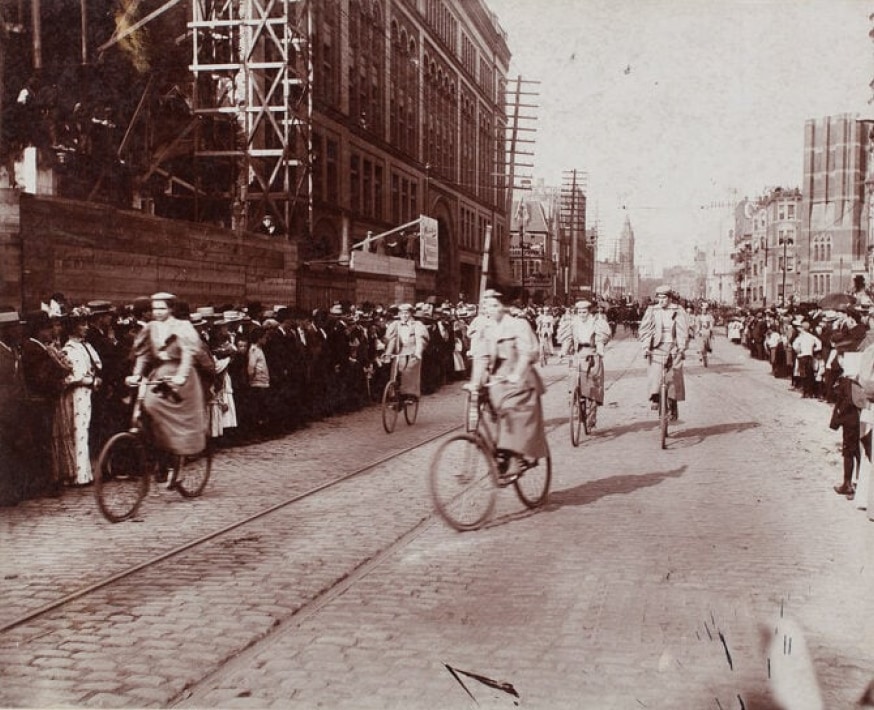
    Thousands of bicyclists rode an 8.5 mile parade route through Boston on August 29, 1896, including ladies with and without escorts” and members of “colored” clubs that were, according to the Boston Herald, “a credit to their race and a valuable contingent among the bicycling throng of good citizens.” Gift of William Sumner Appleton, Feb. 28, 1938.

    What aspect of Kittie’s life did you choose to write about?

    Patrick: My play’s main focus is the League of American Wheelmen’s (LAW) National Meet in Asbury Park, New Jersey, in the summer of 1895. The LAW had recently imposed a color bar to their membership, prohibiting Black members from joining; however, Kittie was already a member. She was the only person of color to show up at the meet, in the intentionally segregated community of Asbury Park, and she insisted on riding.

    I’m blown away by her bravery and her refusal to take “no” for an answer. It’s worth noting that she did receive support from the Massachusetts delegation, who pushed for her to ride. One important aspect of this play, and the plays overall, is the reminder that racial segregation is not a default state. Cycling burst onto the public scene in the 1890s with a fervor that’s hard to comprehend: it was sport, it was social, it was accessible. It also wasn’t universally racially segregated. Cycling clubs in the south pushed the national organization to segregate. Segregation is not a natural state of being, it is imposed.

    Claire: My play is The Ball, the last in the trilogy. At its core, this play balances the joy of celebrating Kittie’s life and the tragedy of her early death. It is set at a time in Kittie’s life when storm clouds of grief have gathered, but, true to her character, she dances anyway. One of her closest friends and fellow Black female cyclists, Viola Hamilton, passed away unexpectedly from appendicitis between the second play and the third. Kittie and her friends are trying to pick up the pieces personally, while politically their wellbeing also is threatened by more and more segregationist legal wins.

    In writing this play, I referenced newspaper clippings from balls Kittie actually attended. She is noted in the papers for her beauty and the exquisite tailoring of her dresses. Kittie knows she’s being watched by many people hoping for her downfall, and she decides that, if they’re watching, she might as well be dancing.

    Historic New England’s Eustis Estate in Milton, Massachusetts, will host three performances of The Kittie Knox Plays on September 20, 2025. All will be performed outdoors—with bikes! Tickets are free, but you must register in advance to attend.

  • In the early twentieth century, industrial workers in Haverhill, Massachusetts, had small amounts of extra leisure and money for the first time. This created new opportunities for the city’s restaurant industry, which responded to the growing spending power of the middle class by creating dining options for workers and tradespeople who had only short breaks during long shifts. A variety of eateries flourished near Haverhill’s factories, serving quick and affordable meals to their workers.

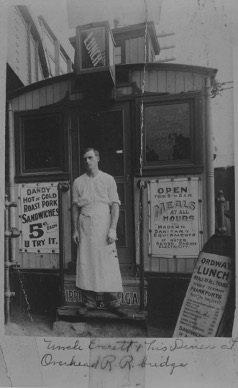
    Lunch wagons were among the most efficient and affordable dining options, becoming a crucial part of many workers’ daily routines. A photograph of Everett Ordway in front of his lunch wagon near a railroad bridge in Haverhill contains a wealth of information about what was available to workers at the time. Open from 6 a.m. to 2 a.m., Ordway’s business hours reflected the overlapping shifts of the workers he served, promising “meals at all hours” and “modern sanitary equipment of water, sewer, gas and electricity.”  His menu featured standard American fare such as lamb chops and beef stew alongside German “Frankfurts, best in the city,” which would have appealed to European immigrants looking for the comfort food of home.  None of his dishes cost more than twenty cents, and his five-cent “dandy hot or cold roast pork sandwich” was likely one of his most popular offerings for hurried workers.

    Everett C. Ordway, Ordway’s Lunch. N.d. Photograph courtesy of the Haverhill Public Library.

    Workers in the shoe factories on Essex Street—now part of Historic New England’s Haverhill Center campus—had a convenient lunch wagon directly across the street: White’s Lunch Wagon, a mobile lunchroom George Washington White opened around 1913. White was born May 26, 1856, in Marlborough, New Hampshire, to farmers Lorenzo and Avila White. By 1860, the couple had seven children, and though George attended school for a time, he was working as a farm laborer by age fourteen. By the 1880s, as industrial work called many young people away from agriculture, George left farming to work in a local wool mill. At that time, he was several years into his first marriage, and he and his wife Georgianna had a son named James. The marriage didn’t last, however, and the pair divorced in 1884.

    The following year, George married Carrie Smith. Their daughter Alma was born in 1888, and the family soon moved from Marlborogh to the town of New Durham, close to the Maine border, where George found work as a knife grinder. This likely put him in proximity to the grocery or catering industry. In 1902, George’s second marriage also ended in divorce. In 1908, George married his third wife, Clara Fitzgerald, who brought with her a young son, Ralph. The couple began their married life in Farmington, New Hampshire, but soon moved to Haverhill, where George began his long career running lunchrooms and supplying Haverhill’s workers with convenient and affordable food.

    George’s first lunchroom, in 1909, was located at 20 Vine Street, on the edge of an immigrant neighborhood known as “The Acre.” It was most likely a homespun affair run out of the couple’s own kitchen. By 1910, George had moved his operation to 15 Emerson Street, closer to the rows of homes and businesses along the river. In this iteration of the lunchroom, his wife Clara was listed as the cook, and the Haverhill City Directory registered it as an official restaurant.

    By 1913, the family rented a home at 36 Pleasant Street and George’s “lunch” appeared in city lists at 152 Essex Street for the first time. This large, elaborate version of a lunch wagon most likely included a small counter with stools inside, making it a precursor to the classic American diner. George’s stepson Ralph worked as a waiter, and the lunch wagon employed a cook while Clara remained at home. The location was a wise one, providing a steady stream of tired, hungry workers eager to buy food on their brief shift breaks.

    When White died, obituaries called him a “luncheon proprietor and automobile dealer,” suggesting that his success in the lunchroom business had allowed him to expand into other areas, as well. The single surviving photo of White’s Lunch Wagon is not just a record of a business, it is a reminder of the role White played in the daily lives of the workers he served, and of the ways that food can bring people together, bridging differences, sustaining traditions and nourishing communities.

    Written by Eleanor Martinez-Proctor, Study Center Fellow

  • The 1890s were turbulent years in New England—and Haverhill, Massachusetts, was no exception. Following the financial panic of 1893, the “Queen Slipper City” quickly felt the effects of the national economic decline. At that time, Haverhill’s booming factories produced ten percent of the country’s shoes, employing a workforce of over 11,000 men and women engaged in cutting, stitching, lasting, trimming, and packing at over 230 factories. When the economy struggled, however, consumer demand for shoes decreased. An unexpected increase in the cost of leather cut further into profit margins, and employers quickly turned to several austerity measures to recoup their losses. They initiated a wave of lockouts, firings, and unfair “ironclad” contracts while allowing working conditions to decline, leading to a massive general strike in 1895 in which over 3,000 shoe workers left the factories in protest. 

    The strike was a warning for the local government. Haverhill’s workers wanted more for themselves and their families. They wanted better alignment with national unions, and they wanted the local government to recognize their needs more responsively. It was an ideal moment for advocates of municipal socialism to find a voice, and one of the first to make themselves heard was James P. Carey. 

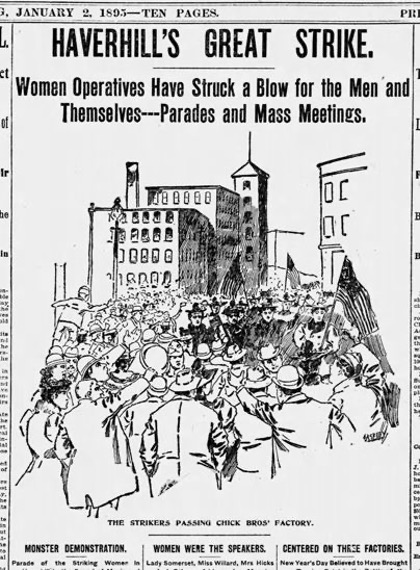
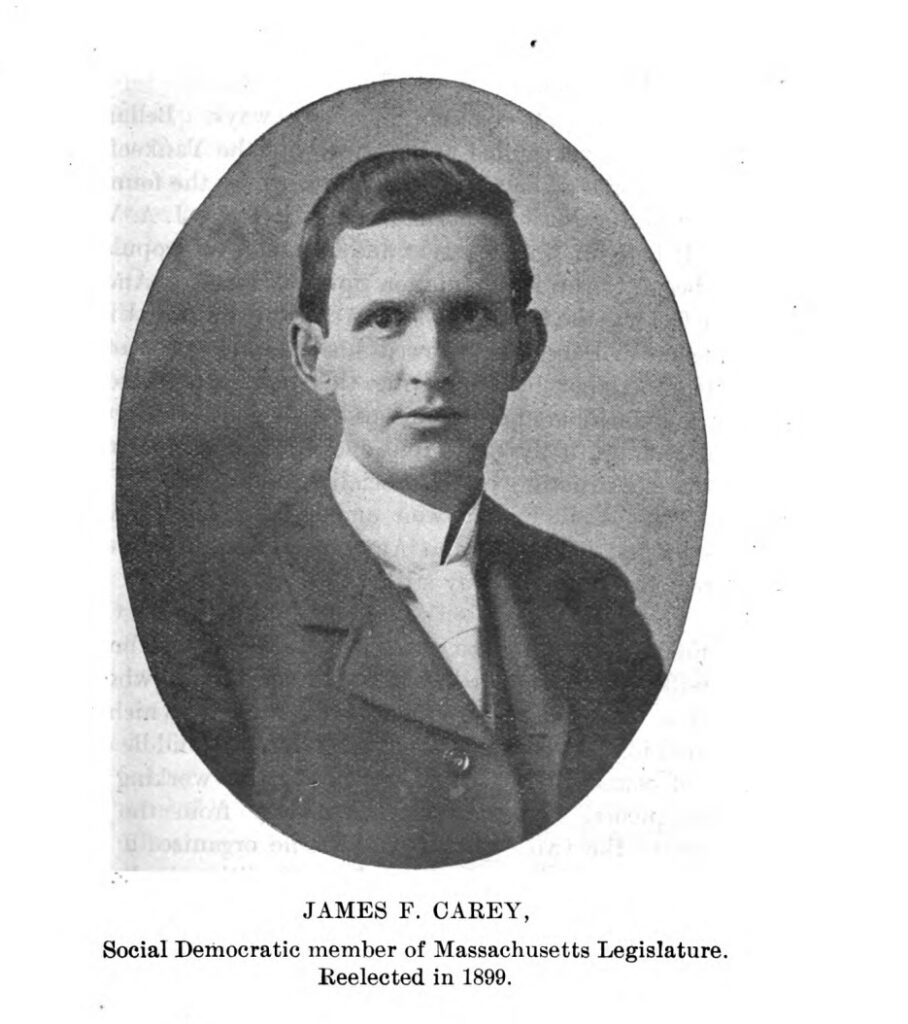
    Carey, born in Haverhill to Irish parents, helped lead the Great Shoe Strike, organizing what The Boston Globe called a “Monster Demonstration” of over 1,500 workers who marched past the factories on River Street on New Year’s Day in 1895. A lifelong shoe worker himself and a charismatic speaker, Carey was the first to address the crowd of strikers that afternoon. He spoke pointedly to women’s equal participation, declaring, “Wax dolls are good and they do not strike, but it is better that women be good for something and that they do not stand idly by and see their brothers beaten down by themselves by a club in the hands of the capitalists.” The crowd cheered wildly when he asserted that the ironclad contract system directly opposed the Declaration of Independence and by the time he left the stage, all of Haverhill’s striking workers knew Carey’s name. 

    Newspaper illustration of a women's strike with a crowd in front of factory buildings holding flags. Transcribed Text: HAVERHILL'S GREAT STRIKE. Women Operatives Have Struck a Blow for the Men and Themselves---Parades and Mass Meetiings. The Strikers Passing Chick Bros’ Factory.
    The Boston Globe, January 2, 1895.

    First a populist and then a nationalist, Carey’s time working in Haverhill’s shoe factories eventually exposed him to a wide range of socialist thought. The revolutionary doctrines that swept across Europe during the nineteenth century found their way to factory floors in New England, where workers were influenced by the writings of Karl Marx and Friederich Engels. Driven by a strong belief that workers should have some ownership of production systems, Carey had previously helped to organize the Haverhill chapter of the Socialist Labor Party (SLP) and had been elected to the Haverhill City Council on their ticket in 1894. After the strike in 1895, he ran for mayor as an SLP candidate and although he did not win, he took a six percent of the vote, which was a significant advance for the socialists. 

    A public scandal occurred soon after the strike concluded, when several local aldermen were convicted of “boodling,” or selling illegal liquor licenses for personal gain. The trial provoked widespread disgust at establishment politics in Haverhill. Capitalizing on the moment, the SLP advanced another prominent local socialist, John C. Chase, to pair with Carey and work together on a strategy to bring Haverhill city government under socialist control. Chase was a New Hampshire native who had worked in factories since childhood. He already had a good deal of labor organizing experience, having joined the Boot and Shoe Workers Union several years earlier and served as a delegate at their annual convention. As a result, he was blacklisted when he arrived in Haverhill in 1890 and was unable to find work in the shoe industry. He instead worked at a cooperative grocery store and started the Haverhill Social Democrat, a newspaper which soon became a voice for the working class in the city.

    Together, Carey and Chase strategized and ran a strong campaign for election to the Common Council in 1897. While Carey won a seat and Chase did not, they pressed forward for the SLP. The next year, Chase successfully ran for mayor of Haverhill. At the same time, Carey won a seat on the State Legislature, bringing with him a progressive agenda that reached even further towards socialist governance and nationalized public utilities. Although James Carey’s appointment gave him a broad platform for advocacy, John C. Chase’s victory brought Haverhill the national distinction of having the first socialist mayor ever elected to office. 

    Black-and-white portrait of a man in a formal suit, set in an oval frame. Transcribed Text: JAMES F. CAREY, Social Democratic member of Massachusetts Legislature. Reelected in 1899.
    James F. Carey. Courtesy of HathiTrust.

    The early twentieth century was central to Haverhill’s story of intertwined labor and socialism. Eugene Deb’s Socialist Party of America emerged, advocating radical inclusivity as a path to success and bringing in previously overlooked factions. Socialist candidates soon won seats on the city council and the school committee, and although the national labor campaigns of the early twentieth century brought strikes to Haverhill through the mid-1930s, the city flourished as it increasingly adopted socialist principles. Bolstered by a strong working-class population and a hard-won but steady rise in job satisfaction, Haverhill’s population and property valuation increased through World War I. Clubs and reading groups, as well as benefit and educational societies continually sprang up throughout the city, further empowering workers and their families. 

    Newly-arrived immigrant groups settled into cohesive neighborhoods and formed cultural bonds while also finding acceptance in the broad embrace of socialist-led labor unions. The socialist city government of Haverhill successfully pushed through policy initiatives around healthcare, education, utility services, municipal projects and child labor. Haverhill’s “old” political corruption was largely eradicated. After his term as mayor, Chase turned his eye to the national scene; he made gubernatorial bids in Massachusetts and New York and ran for congressional seats in West Virginia and Ohio, all without success. Carey remained in Massachusetts, an active, devoted, and sometimes outspoken socialist who served in many capacities, including as the party’s state secretary.

    Despite its successes, the course Haverhill charted through socialism at the turn of the century faced challenges and opposition. The general fear and hostility directed at socialists as “wild radicals” persisted even as socialist organizations worked to improve the lives of workers across the country. Practical and theoretical divisions within the larger socialist movement sometimes threatened the unity that was so essential. The labor wars of the early twentieth century were often violent, with tragic human costs preceding worker’s rights as we know them today—but nowhere in America was the idea of a socialist utopia closer than in the streets and factories of Haverhill, led by stubborn visionaries like James Carey and John C. Chase. 

    Written by Eleanor Martinez-Proctor, Study Center Research Fellow
    Photos of Carey and Chase are from Frederic Heath, Social Democracy Red Book: A Brief History of Socialism in America. Terre Haute: Debs Publishing Co., 1900. Courtesy of HathiTrust.

Close